The Mechanical Unconscious

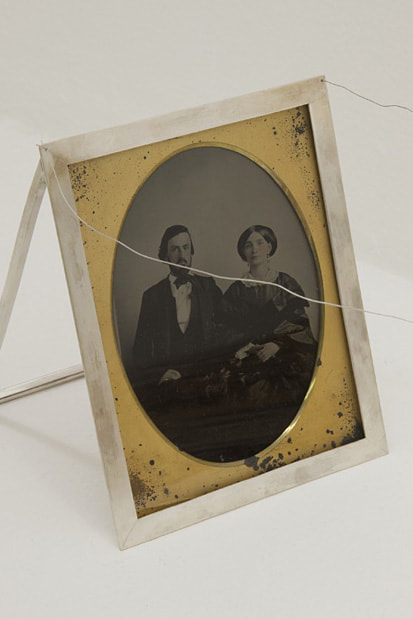
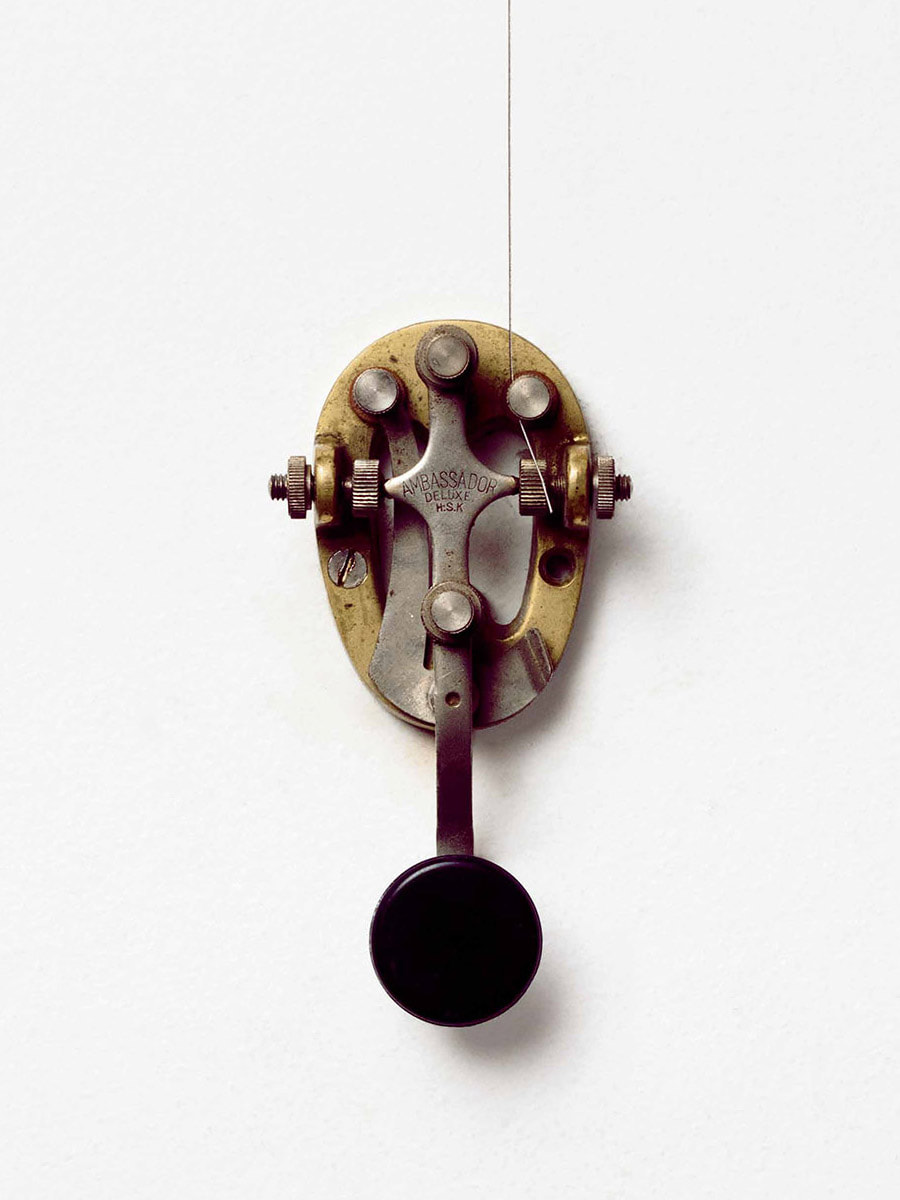
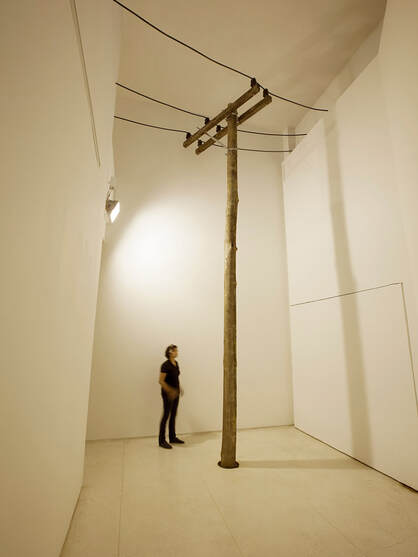
The exhibition space resembles that of an empty and abandoned albeit fully functioning laboratory. The works are mechanisms; at first sight, they are utterly anachronistic. The scene possesses a dreamlike quality. But what type of experiment is there in unceasing execution if the mechanisms appear to have taken on a crazed, disordered life of their own as redress for their utilitarian obsolescence, disobliged from their corresponding function the irrational revenge of the machines? How could we have kept up our relationships to these strange things for so long? This thing that, up until a while ago, had been a telephone what is it now? A curious object, possibly, but no more. In Chaplin's Modern Times, man struggled with enormous mechanical machines. Nowadays he does not even do that. The thing that threatened Charlie has hidden itself. It has vanished from sight to become possibly even more threatening. So this exhibition suggests the drawing of a parabola: the sonorous evocation of mechanical life through contemporary technology. The digital signs, the synthesized voices and the electronic noises that ring incessantly and madly mimic the paraphernalia of sound that surrounds us, like a continuous, insistent and fruitless prayer to the mechanical unconscious. The litany of sounds would awaken those mechanisms, bring them back from their sleep, restore them to existence and remind us of alienation, yet these noises also happen to be the infernal din of that which we call progress, which gives life while simultaneously annihilating it.

text by Paulo Venancio Filho

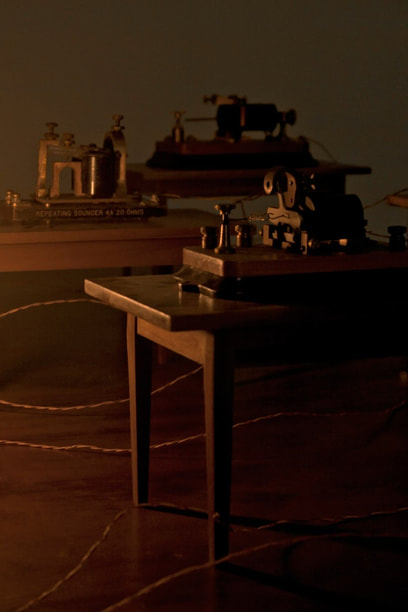
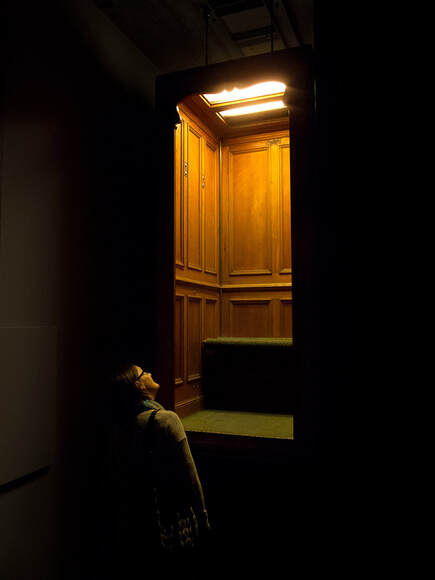
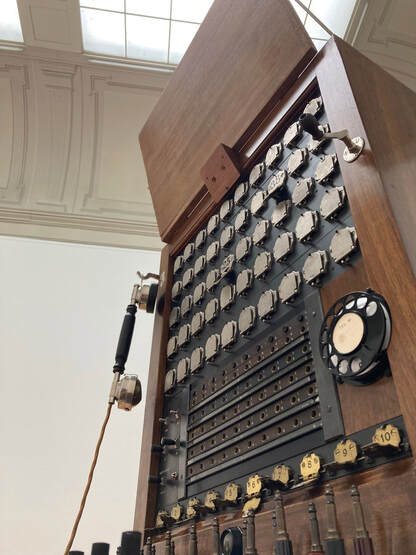
The Mechanical Unconscious proposes an investigation into the nature of language and communication between objects. The dynamic use of sound was executed with rhythmic analysis and synthesis software developed by Sergio Krakowski. Based on these programs and on the choice of captured sound materials, the artists created the first version of the exhibition which remained on exhibition at São Paulo’s Centro Cultural Maria Antônia from June to October 2010, curated by Paulo Venancio Filho. At Anita Schwatrz Galeria, new elements have been introduced to the exhibition in the form of precarious lighting provided by an old incandescent light bulb and the presence of a series of telegraph machines on a wooden platform suspended in the empty space of the gallery.

Otavio Schipper holds a degree in Physics from the Universidade Federal do Rio de Janeiro. He began his visual arts studies with coursework at the Parque Lage and as an assistant to photographer Pedro de Moraes. He did research work on 3D photography with the computer graphics group at the Instituto de Matemática Pura e Aplicada. He participated in the following exhibitions: “Arte Brasileira Hoje” (Museu de Arte Moderna do Rio de Janeiro and Pinacoteca do Estado de São Paulo, 2005), the twelfth edition of the Salão da Bahia (Museu de Arte Moderna da Bahia, 2006), the fifth edition of the Salão Nacional de Artes de Goiás (2006) and Nova Arte Nova (Centro Cultural Banco do Brasil RJ / SP, 2008). In 2007 he held his first solo exhibition “Borda de Dobras” at the Galeria Millan in São Paulo and, in 2008, the solo exhibition “Fluido Percurso” at Rio de Janeiro’s Paço Imperial. In 2010 he presented the sound installation “Mechanical Unconscious” at the Centro Cultural Maria Antônia in São Paulo.

Sergio Krakowski holds a doctorate in Mathematics from the Instituto de Matemática Pura e Aplicada. He has worked at the Sony/CSL-Paris lab developing a system that uses rhythm as an interface between musicians and computers. This project was presented at the SIGGRAPH ’09 conference in the poster, talk and performance categories. He created the TelecotecnoFunk project for the Biscoito Fino recording label. This was presented in the Humaitá pra Peixe Festival at the Circo Voador and the SESC Noites Cariocas Festival at the Pier Mauá. He paticipated in the Mostra Internacional de Música de Olinda (MIMO) as part of a trio that included Gonzalo Rubalcaba and David Linx, in musician Francis Hime’s show in Montreux and at the Orsara Jazz Festival as part of a trio with Italian jazz guitarist Lucio Ferrara and singer Cristina Renzetti. He has taught percussion workshops in Milan, London, Brighton, and Montpelier.


Empty Voices

Now the Sirens have a still more fatal weapon than their song, namely their silence. And though admittedly such a thing never happened, it is still conceivable that someone might possibly have escaped from their singing; but from their silence certainly never.

Franz Kafka


Soon silence will have passed into legend. Man has turned his back on silence. Day after day he invents machines and devices that increase noise and distract humanity from the essence of life, contemplation, meditation... tooting, howling, screeching, booming, crashing, whistling, grinding, and trilling bolster his ego. His anxiety subsides. His inhuman emptiness grows like a monstrous gray plant.

Jean Arp

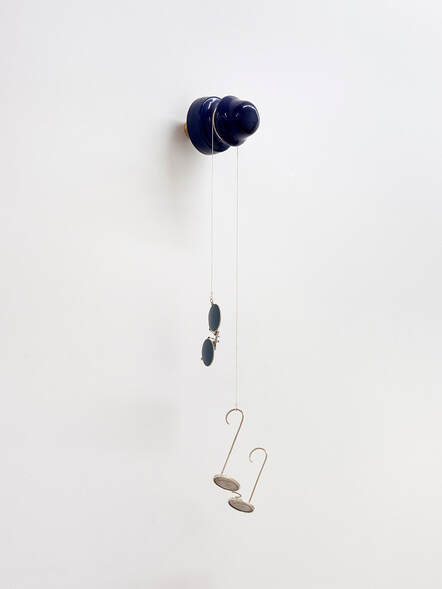
In the artist’s studio, the young photographer in her summer frock stands on tiptoe to peer through the viewfinder of the camera fixed to the extended legs of the tripod as she sets up her shots of these prongs, these u-shaped objects suspended from the ceiling by steel wire and arranged against a background of acoustic insulation paneling. These thin, lustrous elongated forms cannot dissemble their kinship with tuning forks. Their lines are primarily vertical, a few of them horizontally bisected by smaller versions of themselves. A connection to sound is established (visibly? audibly?) from the outset. Yet however much their physicality encourages us to continue to dwell upon form and material, we are soon set to wondering about a sort of admixture that has taken place here and how it was that we never heard the elongated bodies, or the large, flat feet and tiny heads of certain works or listened to the polished surfaces and simple, elegant bird shapes of some others.

Thus far, the artist’s trajectory has encompassed a degree in physics, work in computer graphics and three-dimensional photography and a prodigious output of drawings, none of which prepared anyone for the creation of the Mechanical Unconscious (2010/2011), the fullest expression of an ongoing fascination with – and near-encyclopedic knowledge of – sound.

The degree zero of this new installation is the experience of sound within the field of silence. Whereas, in the Mechanical Unconscious, Schipper investigated the sound (and codifying) of language, what he proposes in this new work is muteness, deafness, a turning inward. He has written that he is “very interested in thinking about the strength and substance of so-called inner voices, and in the energy that this immaterial type of language produces.”

The burnished bronze forms I see hanging before me have appeared previously in another guise as delicate watercolors of oddly disturbing shapes in hues of pale blue, cerulean, a clotted, blood red, orange and pink, suffusing Schipper’s early drawings. As one moves toward them now, the full range of the artist’s readings, conversational references and correspondence over a ten-month period – the elaboration of a dense, rich, multi-layered complex fun house mirror of a system of science, fiction and fact – comes instantly to mind. The leitmotif rings out. It permeates texts by Guglielmo Marconi, La Monte Young, and Giuseppe Tartini (among many others) and it has to do with sonority.

The tuning fork’s principal use as a standard of pitch to tune other musical instruments has been subverted here. Sound frequency is ordinarily defined by the object’s length. The larger the object, the lower the sound emitted by it. The artist speaks: “At first, I wanted to tackle frequencies outside the audible spectrum (infra and ultra sound), but I arrived at the conclusion that it would be more interesting to explore unknown, imaginary frequencies.”

“Ever since its invention, the tuning fork has been used in countless experiments to understand the vibratory nature of sound; a phenomenon known as il Terzo Suono [the Third Sound] caught my attention: when two notes with similar frequencies are emitted, it is possible to perceive a third note. For a long while, there were attempts to decipher whether this third note was produced by a psychophysical phenomenon (an interpretation of the mind) or an acoustic one – to wit, whether this third note is actually, physically emitted). “In an account of one of these experiments, I discovered that it is possible – for example – to hear a given frequency based on the emission of two inaudible frequencies. And I came to the conclusion that the objects and sounds with which we deal in the world are nothing more than a combination of invisible objects."

“I began to perceive silence as a possible result, a combination of infinite frequencies, as if this experience of a ‘third sound’ could be inverted and accelerated. This would justify the fact that the sirens considered their silence an even more terrible weapon than their song.” Adrift in frequencies, drones, vibration, hums, beat, pitch – in the suggestive morphological communications of this activated space – we move carefully and quietly among these highly polished, perverted instruments of a metal alloy used in classical sculpture, these twenty mute pieces, these tuning forks. And yet it is not mere silence that has emerged here as a result of the systematic canceling out of sound. There can be no doubt that the muteness of this installation speaks eloquently. Though we must wait patiently to hear them, these empty voices have long been considered the most powerful, the most mystical ones – the deadliest of siren songs. Look. Hark. We have entered a labyrinth. We are inside an echo chamber.

Text by Stephen Berg

+info